Skip to main content Skip to main navigation Skip to footer
  • Student Login
  • Educator Login
  • Educators: Sign up for a free trial
  • Home Users: Available at Time4MathFacts
Science4Us home page Science4Us home page
Science4Us home page
  • Explore
    • Explore All
    • Physical Science
    • Life Science
    • Earth/Space Science
    • Inquiry Science
  • About
    • Explore Science4Us (Take a Tour)
    • Curriculum
    • Literacy-Infused Science
    • K-5 Science Learning
    • Testimonials
    • Correlations to K-2 Standards
  • Research
    • The Research Behind Science4Us
  • Support
    • Professional Development
    • Help Center
    • Site Status
  • Resources
    • Educator Resource Hub
    • Success Stories
    • Insights
    • Free K-2 Science Resources
  • Get More Info
    • Educator Sign Up
    • Home User Sign Up
    • Request Purchasing Info
    • Request a Demo
    • Request a Pilot
    • Contact Support
  • Login
    • Student Login
    • Educator Login
  • Sign Up for Free
    • Educators
    • Home Users
Science is for everyone. Learn the skills teachers and students need to succeed in science and STEM. Plus, find printable and digital resources to support science instruction and learning. https://www.explorelearning.com/user_area/content_media/raw/anatomyofscientist-thumbnail.jpg
  • Home
  • Insights
  • Article

Anatomy of A Scientist: Skills Teachers and Students Need to Succeed in Science

  • Teaching Strategies
  • Science4Us
Boy standing in front of science images with a...

 “I don’t understand science.” “Girls can’t do science.” “This is hard.” This mindset could be hindering both you and your students when it comes to science.

Whether you’re teaching AP chemistry or second-grade science alongside four other subjects, you can empower yourself and your students to be confident and capable in science instruction and science learning with the following resources.

Science Means More Than Scientific Knowledge

True, “hard” science skills (like analyzing and predicting) are needed for success in science. But so are social and emotional skills (like collaboration and self-awareness). Students need to not only be able to observe and describe the world around them and to predict and reason, they need to be able to work with others and communicate. Fostering a growth mindset in your students will help them develop both sides of the scientist equation.

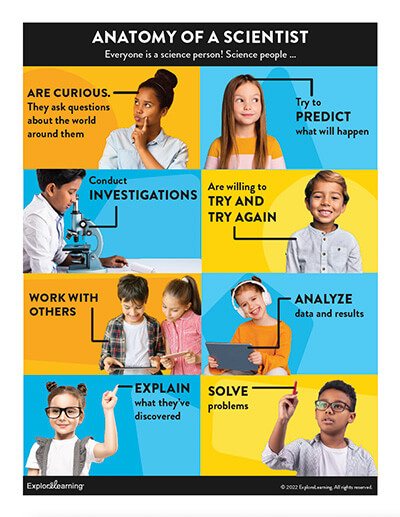
Find the skills that make a successful scientist in our Anatomy of a Scientist poster below. Download to display in your classrooms.

Anatomy of a Scientist
Anatomy of a Scientist

Science is for everyone! Scientists …

  • Are Curious. They ask questions about the world around them
  • Try to Predict what will happen
  • Conduct Investigations
  • Are willing to Try and Try Again
  • Work with others
  • Analyze data and results
  • Explain what they’ve discovered
  • Solve problems

Download the Poster

Teachers Need the Right Mindset too!

As science curriculum, budgets, and resources change almost daily, teachers themselves might need to build confidence in teaching science. As you take a look at your science instruction, be sure to consider your instructional mindset as well. A teachers’ growth mindset can greatly affect student performance, leading to improved science skills. When you reexamine your perceptions of ability and adopt a confident and encouraging mindset, you can see an improvement in your students’ attitudes towards science.

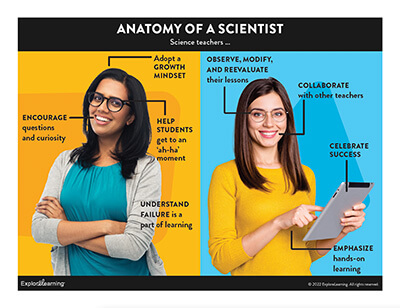
Remind yourself of the skills you need–and have–to help your students succeed in science with this Anatomy of a Science Teacher poster.

What Makes A Science Teacher Great?

Science Teachers…
Anatomy of a Scientist - Teacher

  • Adopt a growth mindset
  • Observe, modify, and reevaluate their lessons
  • Encourage questions and curiosity
  • Understand failure is a part of learning
  • Collaborate with other teachers
  • Emphasize hands-on learning
  • Celebrate success
  • Encourage communication and discussion
  • Help students get to an ‘ah-ha’ moment

Download the Poster

More Science Resources and Tools

Build science skills and confidence with ExploreLearning science solutions.

Gizmos (Grades 3-12)

Virtual math and science simulations that bring powerful interactive learning experiences to your classroom. More than 550 Gizmos help students dig deeper into STEM subjects and really understand challenging concepts.

 Sign up for a free 30-day trial 

Try Gizmos Today

Science4Us (Grades K-2)

Thousands of online and offline science activities help introduce foundational science concepts that engage your youngest learners' natural curiosity and set them up for STEM success.

 Sign up for a free 30-day trial 

Try Science4Us Today

You might also like these stories...

All Insights

Teaching Strategies

5 Tips for Making Blended Learning Successful

Teaching Strategies

Inspire Kids to Become Scientists with These 5 Tips

Educational Trends

8 Tips to Help Teachers Find Classroom Funding
Science4Us logo ExploreLearning logo

© 2025 ExploreLearning. All rights reserved. Science4Us is a registered trademark of ExploreLearning.

Other Products

Gizmos logo Frax logo Reflex logo
Explore
  • Physical Science
  • Life Science
  • Earth/Space Science
  • Inquiry Science
About
  • Explore Science4Us (Take a Tour)
  • Curriculum
  • Literacy-Infused Science
  • K-5 Science Learning
  • Testimonials
  • Correlations to K-2 Standards
Research
  • The Research Behind Science4Us
Support
  • Professional Development
  • Help Center
  • Site Status
Resources
  • Educator Resource Hub
  • Success Stories
  • Insights
  • Free K-2 Science Resources
Get More Info
  • Educator Sign Up
  • Home User Sign Up
  • Request Purchasing Info
  • Request a Demo
  • Request a Pilot
  • Contact Support

Contact Us

  • Support Form
  • 866-882-4141
  • +1-434-293-7043
  • Newsletter Sign Up
  • Visit the Science4Us Facebook social media site
  • Visit the Science4Us Twitter social media site
  • Visit the Science4Us Youtube social media site
  • Visit the Science4Us Instagram social media site

Other Products

Gizmos logo Frax logo Reflex logo

© 2025 ExploreLearning. All rights reserved. Science4Us is a registered trademark of ExploreLearning.

  • Terms and Conditions
  • Privacy Policy
  • Sitemap
  • ExploreLearning and Learning A-Z Integration
  • Accessibility